Overview
How can Android observe network quality in real time while respecting platform restrictions, persistence needs, and battery limits?
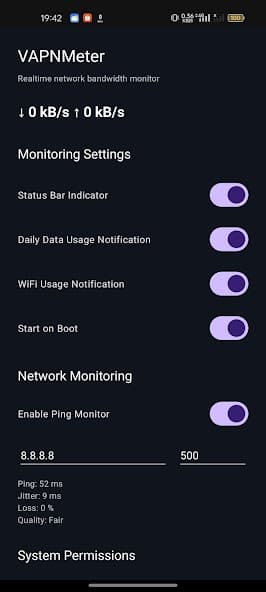
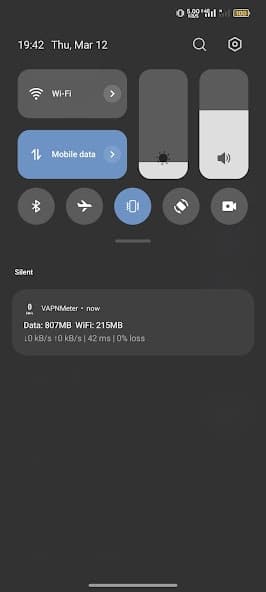
Network speed alone is not enough to explain a poor connection. VAPNMeter brings live traffic, latency, packet loss, daily usage, and speed testing into one Android system.


Problem
The application must maintain useful live feedback while Android limits background work and every sample, wake-up, database write, and network request has an energy cost.
Constraints
- Foreground-service and background-execution restrictions
- Continuous updates without wasteful polling
- Durable daily usage and monitoring history
- Unreliable or changing network conditions
- Actionable alerts without notification fatigue
Architecture
Observation to insight
Select a monitoring responsibility to trace its inputs and outputs. Speed tests are on demand; continuous observation has a different energy budget.
Android network counters and connectivity provide the platform signals.
A foreground service provides the lifecycle boundary for continuous monitoring.
Latency and packet loss describe connection quality beyond raw throughput.
TrafficStats supplies traffic counters for live usage and daily summaries.
M-Lab NDT measures throughput on demand, separate from continuous monitoring.
History and preferences have different persistence responsibilities. Exact write policies need source verification.
Monitoring information becomes readable feedback and actionable alerts; WorkManager supports deferred work.
Trace a relationship
Focus or hover a node to highlight its connections. Select to keep it highlighted; select again or press Escape to clear.
Conceptual architecture from the project brief. Arrows show information direction, not live traffic.
Read all responsibilities and connections
- Android device
- Android network counters and connectivity provide the platform signals.
- Foreground monitor
- A foreground service provides the lifecycle boundary for continuous monitoring.
- Ping / loss
- Latency and packet loss describe connection quality beyond raw throughput.
- Traffic / usage
- TrafficStats supplies traffic counters for live usage and daily summaries.
- Speed test
- M-Lab NDT measures throughput on demand, separate from continuous monitoring.
- Room / DataStore
- History and preferences have different persistence responsibilities. Exact write policies need source verification.
- Insight / alerts
- Monitoring information becomes readable feedback and actionable alerts; WorkManager supports deferred work.
- Android device → Foreground monitor: network signals
- Android device → Speed test: on-demand test
- Foreground monitor → Ping / loss: quality sampling
- Foreground monitor → Traffic / usage: traffic observation
- Ping / loss → Room / DataStore: monitoring history
- Traffic / usage → Room / DataStore: usage summaries
- Room / DataStore → Insight / alerts: history and preferences
- Speed test → Insight / alerts: test result
Engineering decisions
Design rationale from the project brief. Code-level examples and measured tradeoffs are pending verification.
Decision 01
Separate live observation from scheduled work
Foreground monitoring and deferred maintenance have different lifecycle and reliability requirements.
Decision 02
Persist summaries, not every transient signal
The data model should preserve useful history without amplifying write volume and battery consumption.
Decision 03
Treat alerts as product decisions
A technically correct alert is only useful when it is timely, understandable, and not repetitive.
Tradeoffs to validate
Comparison of the design directions in this brief, pending confirmation against the implementation.
- Design direction
- Separate continuous monitoring from deferred work
- Alternative
- Use one polling loop for every responsibility
- Consequence
- Lifecycle coordination becomes more explicit, but background maintenance does not need the same cadence as live observation.
- Design direction
- Persist useful summaries
- Alternative
- Store every transient sample
- Consequence
- Lower write volume sacrifices raw historical detail. Sampling and aggregation policies need measurement before this tradeoff can be quantified.
Implementation
Implementation scope based on the supplied project description.
Observe connection quality
Foreground-service monitoring combines live traffic, ping, and packet-loss information. TrafficStats supplies Android traffic counters; M-Lab NDT covers speed testing.
Keep useful history
Room supports monitoring history and daily usage, while DataStore handles application preferences. Sampling and write frequency are key battery tradeoffs.
Schedule and inform
WorkManager and smart alerts connect background work to useful feedback. Exact scheduling policies and alert thresholds still need implementation evidence.
Challenges and reliability
Reliability concerns that shape the engineering work:
- Lifecycle-aware monitoring under Android process constraints
- Failure-tolerant network checks and changing connectivity states
- Battery-conscious sampling, persistence, and background scheduling
Outcome
VAPNMeter demonstrates end-to-end Android systems work: platform services, networking, local data, scheduling, observability, and product tradeoffs operating together.
Evidence to add
This case study describes engineering scope. Quantified outcomes and implementation claims need supporting material.
- Annotated runtime or persistence code
- Battery and resource measurements with device and test conditions
- Verified alert thresholds and background recovery behavior
Technology
- Kotlin
- Primary Android language
- Android
- Lifecycle, services, platform APIs, and product delivery
- Room / SQLite
- Durable local data and queryable history
- DataStore
- Typed application preferences
- REST API
- Mobile-backend contracts and failure handling
- Foreground Service
- Lifecycle-aware continuous monitoring
- WorkManager
- Constraint-aware scheduled work
- M-Lab NDT
- Independent network speed testing